Russian Africa Corps deploys FPV kamikaze drones in Mali, sky already contested
A full version of this article was originally published on 4 June 2026 on Military Africa. Red H#sh Magazine is reposting on 11 August 2026 at the request of a reader. The original article can be read here.
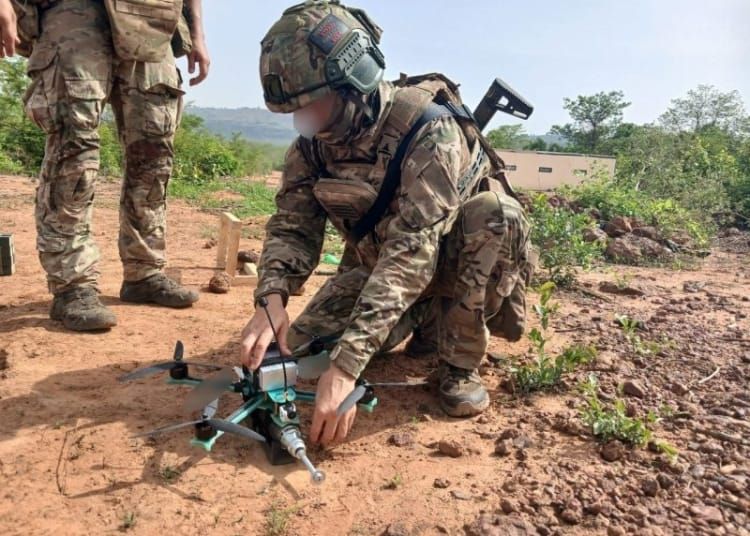
In early June 2026, Russia’s Africa Corps quietly announced something significant. Through posts on X and Facebook, the force confirmed it is now deploying first-person view (FPV) kamikaze drones in Mali – compact, low-cost suicide drones that have become the defining weapon of modern asymmetric warfare. It was framed as a capability milestone. In reality, it was an admission that the battlefield has changed, and the Africa Corps is scrambling to keep up. Because the rebels were already there.
For years, the Russia-backed forces operating in Mali — first as the infamous Wagner Group, now rebranded under the Russian Ministry of Defence as the Africa Corps — enjoyed a clear technological edge in the air. They flew Turkish-supplied Bayraktar TB2, Akinci tactical drones alongside Russian-made loitering munitions, including Shahed-type systems such as the Garpiya-A1. These are serious, expensive platforms — the kind that state armies field, not insurgents.
Today, the Africa Corps operates in one of the most contested airspaces in sub-Saharan Africa, not because of rival air forces, but because of cheap commercial drones in the hands of determined rebel groups. The organisation now fields FPV drones of its own, but it does so in a sky already buzzing with hostile unmanned systems aimed directly at Russian and Malian government forces.
The Africa Corps coordinates airstrikes and ground movements alongside the Malian Armed Forces using tactical UAVs. But rebel coalitions chiefly the Azawad Liberation Front and the al-Qaeda-affiliated Jama’at Nusrat al-Islam wal-Muslimin have been hitting back with FPV kamikaze drones and artillery, inflicting real damage at key positions including Aguelhok and Anéfis.
The Sahel has become eastern Europe’s mirror
For military analysts watching both theatres, the parallels are impossible to ignore. What began as a Ukrainian innovation — adapting cheap commercial drones into precision weapons against a technologically superior adversary — has been replicated with striking fidelity in the Sahel. Both state-sponsored Russian proxy forces and local insurgent networks now rely heavily on cheap, consumer-grade, and modified FPV drones to offset traditional military power. The same tactics, similar hardware, and nearly identical video footage of drone strikes circulate across both conflict zones.
The Africa Corps has now officially entered this dynamic by fielding its own FPV systems. That announcement, made via social media in June 2026, marks an acknowledgment that the group must match the insurgents’ capabilities rather than simply overpower them with heavier assets. The proliferation of rebel FPV strikes, combined with logistics bottlenecks, has already forced the Africa Corps into a far more cautious, defensive, and risk-averse posture than the Wagner Group ever adopted.
The drone war in Mali is no longer a curiosity or a footnote to the main conflict. It is the main conflict. And both sides are now fighting it with the same weapons.